
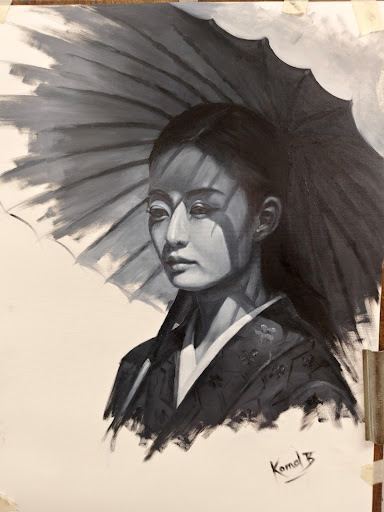
A Sunny Day
A Sunny Day
Hibakusha!
Was it a word born of compassion, or was it given to the survivors of the atomic bomb as a mark – like cattle branded at birth… defective? Kimora often wondered. More than ninety-nine thousand people had been named Hibakusha. Perhaps they should all have migrated to an island and called it that – proudly. For they had survived. Survived one of the most inhuman acts in the history of humankind.
When Kimora was a little girl, her grandmother enticed her with stories. They were filled with demons and heroes, with magical lands where bright flowers bloomed in impossible colours. One could enter those lands wearing cloaks that made one invisible, slipping quietly into the story, becoming part of its secret heartbeat.
But when humans had tried to become gods, entire cities had vanished – disappeared in the name of peace and war. In those lands there were no flowers. No trees. No magic. Only a vast tomb that had collapsed upon itself.
Kimora had stood centre stage in that story.
It was a beautiful sunny day at school when the ‘Little boy’ dropped from the sky.
One moment they were solving math problems. The next, a blinding yellow light swallowed the room. Then came a brownish-red haze – dust, debris, and fire fused together in a terrible alchemy. Death claimed many lives that day. Those, perhaps, were the lucky ones.
The others wandered in the land of nowhere – crawling, staggering, searching desperately for something that might quench the inferno raging inside their bodies.
Kimora saw them. The crawlers and the dead.
She saw her teacher – her womb torn open, the charred baby still visible within, attached not for life but in death. The larger skull and the smaller one, together in an unspeakable stillness. Another student hobbled past on bony legs where feet had once been – only flaps of skin trailing where flesh had burned away.
These were the memories Kimora wished she could erase.
Once she had seen an American movie in which people erased their memories and emerged anew, unburdened by the past.
How I wish I could do that, she had whispered to herself more times than she could count.
The minds that created the bomb should also have created the device that erased the nightmares it left behind.
And yet, why was she teetering once again on the edge of those old memories?
Kimora glanced around.
She was sitting in the doctor’s clinic.
New life pulsed quietly within her womb.
Is my baby okay?
The question remained unspoken, but her gynaecologist heard it anyway.
“Yes, yes, the baby is fine,” the doctor reassured her gently. “You have nothing to fear. All your tests are negative. There is no radiation poisoning affecting the child.”
Beside her, her husband exhaled and smiled with relief.
He was not part of the Hibakusha. And yet he had married her, despite the risks.
When he had first proposed, she had told him plainly, almost playfully:
“If you marry me, I will come with an entourage – radiation sickness and deformed children. You will be the father of monsters.”
She had laughed as she said it.
He had seen through the forced lightness in her voice. Taking her hand, he had said softly, “I love you… all of you. And all the monster children we might have. We will live happily ever after in our grand castle.”
Now, as she walked out of the hospital, the doctor’s words echoed in her mind.
Nothing to fear.
Yet even today she carried an umbrella, unable to look up at the sun. The brightness still threatened to become that blinding yellow flash, carrying with it the imagined stench of burning flesh and dust.
But today felt different.
A quiet surge of gratitude rose within her.
From the little girl who loved magical stories…
to the little girl who grew afraid of sunny days…
to the woman who found love…
to the woman who had finally discovered peace.
Kimora closed her umbrella firmly.
Then she looked up at the sky.
“It is a beautiful sunny day,” she said.
Leadership Lesson
Every person carries invisible stories.
Moments of triumph, certainly – but also moments of fracture.
Experiences that leave small cracks in the architecture of self-belief. Sometimes those cracks heal. Sometimes they quietly reshape the way a person sees themselves.
Many people who appear quiet, hesitant, or disengaged are not lacking in capability. They are carrying memories – of harsh judgment, dismissive feedback, public embarrassment, or moments when their worth was questioned.
In organizations, this is a common yet invisible tragedy.
High-potential individuals often retreat into safe anonymity – not because they lack ambition, but because something in their past convinced them that stepping forward is dangerous.
A careless comment from a manager.
A humiliating meeting.
A moment when effort was met not with guidance, but with scorn.
These become professional scars.
This is where leadership matters.
Empathetic leaders do not merely measure performance; they listen for the stories behind it. They understand that confidence is not simply an individual trait – it is also a product of the environment leaders create.
Great leaders balance task focus with deep human awareness. They see potential where others see hesitation. They create spaces where people can rebuild their belief in themselves.
Leadership, after all, carries enormous power.
A leader can elevate a person toward extraordinary achievement – or quietly diminish their sense of worth.
But responsibility does not lie with leaders alone.
Every individual must also decide what meaning they assign to their scars.
The world will always label us in some way – through titles, feedback, or the echoes of past failures. But those labels do not have to define us.
The Hibakusha can be seen as a mark of tragedy.
Or it can be worn as a testament to survival.
The difference lies not in the scar – but in the story we choose to tell ourselves about it.
And sometimes, the first step toward reclaiming that story is simply to look up again… and rediscover that it is, indeed, a beautiful sunny day.
List of Comments
Leave a Comment