
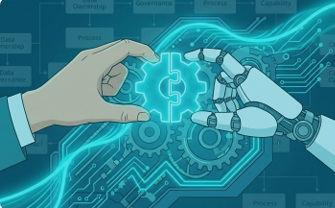
Beyond the Emerald City: Workforce management technologies are converging – good, but not enough
In a relatively short time, HR technology has evolved from a small set of record-keeping systems into a bewildering bazaar of categories, sub-categories, logos and “modules”, most now proudly labelled AI-enabled, much like washing powder is always “new and improved”.
Whichever part of HR you work in – Reward, talent, learning, analytics, employee relations, service delivery – there’s a category or two for you. I live in workforce strategy and strategic workforce planning, so it won’t surprise you that I’ve been watching the recent explosion in workforce management (WFM) technologies – the wider ecosystem of tools, not just scheduling with particular interest.
Why? Because it’s these technologies that should enable HR to play an equal-partner role in business appraisal and decision-making – almost.
“Almost” is doing a lot of work there. There’s still a gap between what the tools could enable and what most organisations can actually do with them, and that’s because the missing piece isn’t just technology.
Convergence is real, but without interpretation and execution built into the flow, we’ll just get smarter dashboards feeding the same old fragmentation.
So let’s consider what current WFM technology components are and what they can do, consider what they could do together, and set out the operational changes necessary to capitalise on this capability.
Current capability
WFM technologies attract a lot of fancy titles, but they effectively do one (sometimes more) of three things:
Describe what’s happening (and what’s likely)
Interpret what it means for the business
Decide what to do about it.
What’s happening
Products have become very good at telling us what the situation is. People analytics pulls signals from HRIS data. Org design tools surface structural stress. Skills/talent platforms map capability. Market intelligence shows what’s happening outside your walls.
They often go further – projecting likely workforce trends based on (for example) historical attrition and mobility data, benchmarking one company’s state against their peers. Though primarily concerned with supply-side analysis, these are still good and useful capabilities.
The early signs of convergence are that these signals are starting to get stitched together and, increasingly, routed into planning and workflow tools rather than left sitting in separate dashboards.
The problems start with item number 2.
What it means
I’m often asked which skill matters most in SWP. I could write a book on that (I nearly have). But the word I keep coming back to is synthesis.
There are multiple SWP catalysts currently in play – geopolitical turbulence, pushback against globalisation, ageing workforces, shortages of talent. Throw AI into the mix, with its overtones of disruption and you have an almost perfect storm of uncertainty about the future for the nature of work and workers. The SWP practitioner needs to be able to consume all of these forces, add things like future business strategy and all of the different technology signals and…make sense of all of it.
Making sense means being able to overlay these different factors and determine where the problems of substance really are. Most organisations lack integration and decision context anyway — and the technologies aren’t much better yet – which means you get insights without implication. Dashboards without decisions. You don’t discover what you should be worrying about.
Doing something about it
We have an abundance of different technologies designed to take action – reward systems, learning, workforce planning, resource assignment, talent acquisition, purchasing, contractor management, to name just some. But without the synthesis in the middle, these systems will never be any better than partially informed.
In my own specialty of Strategic Workforce Planning, too many of the products available are little more than cloud-based tables of expected headcount numbers and associated cost. This is fine for answering the question, ‘How many employees can I afford next year’, but not much use in answering something like, ‘What capabilities do we need to execute our strategy and remain competitive?’
But there’s more.
A number of technology vendors are now augmenting their existing people analytics, OD, talent management and market intelligence platforms with workforce planning or strategic workforce planning modules, either through development or acquisition. It’s as though workforce planning has become the Emerald City (I know you were wondering what that had to do with anything) and these vendors have rightly, in my view decided that SWP is where their intelligence can be turned into value.
But can it?
The clue is in the name. A plan does not create value. Execution does and, critically, the ability to execute better because you planned ahead. The Yellow Brick Road doesn’t end at the Emerald City; it stops there – importantly – but it carries on.
What could good look like?
It looks like all of these things joined together – internal and external intelligence consumed and fused with business strategy, interpreted in context, turned into prioritised choices and actions. Actions are then monitored to improve future cycles.
Now, if that sounds somehow familiar, it’s because that’s how most SWP diagrams look today. It doesn’t happen that way because there are too many breaks in the flow, not just of data but of appraisal, judgement, and process.
Let’s break this down a bit, because I think there’s an irony here, in that the technology we already have does most of what this vision calls for: it’s just not being used like that.
Consumption
Many vendors do some of this already: it’s the USP of the people analytics vendors - “we take data from multiple HR sources and derive insights”. What we don’t do is extend the scope to data from multiple applications inside and outside HR, and external sources. Even within HR, the systems don’t talk: talent and market intelligence rarely feed people analytics or planning in a way that tells you whether the plan is doable.
That’s the prize: not more insight, but earlier feasibility - what’s deliverable, what isn’t, and what trade-offs need to happen.
Business strategy and financials frequently aren’t consumed systematically in WFM applications, either because territorial barriers prevent data sharing or because strategy often lives in prose: decks, emails, board papers. If only we had technology that could act on natural language prompts…
Interpretation
For SWP practitioners, the advent of agentic AI should be a really big thing. For the first time, we have a capability that can absorb many dozens of sources and make sense of them. I’ve already created simple agents that identify likely workforce risks for a given sector, country or even job role; if I can do that, so can you.
The key to making this work is going to be a willingness to share data across a much broader spectrum and the ability to know how to write a really good set of prompt instructions.
Choices and actions
Too many workforce plans sit in isolation from the systems in which they are executed, such that a talent acquisition system, for example, may be in total ignorance of the anticipated number of annual hires implied by the planning application.
That’s not to say that plan data should be followed slavishly, because circumstances change. But even a directionally-correct indication helps TA to prepare better, especially if that data is being fed into their systems.
I say again: the technologies we already have can make all of this possible; we just need to be willing to invest in doing so.
Operational fixes
Some obvious elements would need to be reformed or implemented to enable this kind of ecosystem to work as it should:
Data ownership – protocols for data sharing, and single sources of truth.
Governance and guardrails – to ensure this larger pool is used with integrity and sensitivity.
Process – how data flows are enabled, managed, and acted upon.
Capability – the ability to build the flows and implement AI interventions of quality and value.
But I think there’s something more.
Collaboration of data and systems needs corresponding functional collaboration too – not only between Finance, Strategy, HR, the Business, Supply Chain, and anyone else involved in workforce management, but also within HR itself. Too many HR functions remain focused on their own needs and their own objectives. We can see the consequences in daily working life: short-term hiring at a premium, parallel identical initiatives, turf wars, and an operating model that loses sight of business success as the only goal that ultimately matters.
Boldly Go
The old adage - and it is old now - of the NASA janitor who, when asked what they did, replied that they were helping to put someone on the Moon is as relevant as it ever was. Harnessed the right way, HR has the chance to step out of the shadows and contribute fully to business strategy and delivery. There is no business without its people, and the technology we now have enables HR to tell the business things about its people that it needs to hear. All HR has to do is start joining up its own dots and focus on a shared mission.
List of Comments
Leave a Comment