
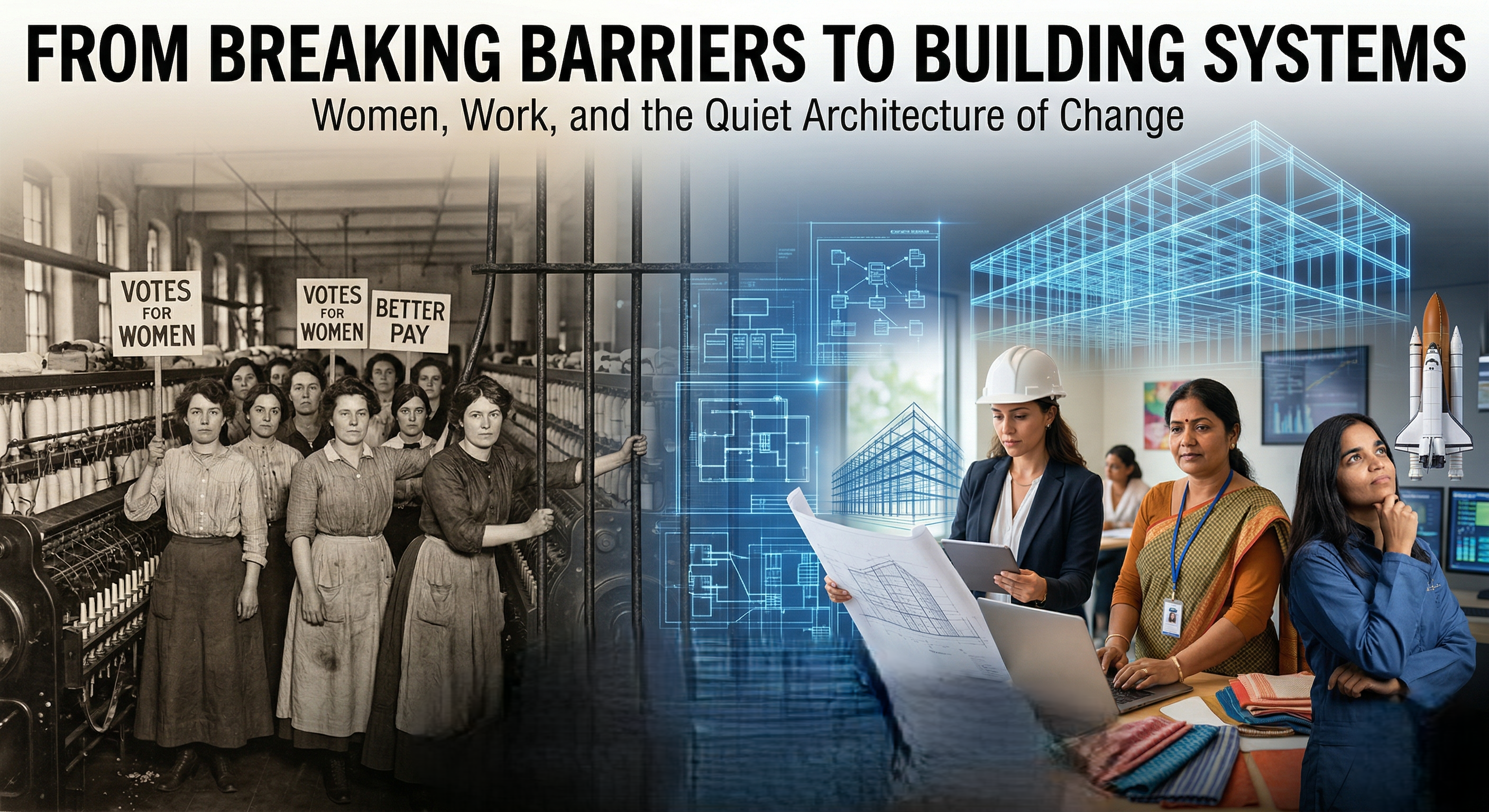
From Breaking Barriers to Building Systems: Women, Work, and the Quiet Architecture of Change
“Systems do not break barriers; people do. And more often than history admits, the people who first bent those iron bars were women who were told they were too fragile to touch them.”
- Jagmohan Bhanver
There are days on the calendar that feel ceremonial – dates marked with polite applause, corporate emails, and bouquets of predictable words. And then there are days that carry the sediment of history within them, layered with protest, persistence, and possibility.
International Women’s Day belongs to the latter.
Historically, it did not begin as a celebration. It ignited as a question.
A question asked by women who stood on factory floors thick with lint and exhaustion. Women who worked fourteen-hour days stitching garments they could never afford to wear. Women whose names were rarely written down but whose footsteps echoed through crowded streets in the early years of the twentieth century.
In 1908, thousands of women garment workers marched through New York demanding shorter working hours, better pay, and the right to vote. The following year, the United States marked the first National Woman’s Day. Soon the idea traveled across the Atlantic. In 1910, at an international conference of working women in Copenhagen, a German activist named Clara Zetkin proposed an annual day dedicated to women’s rights and suffrage. The idea spread like a match across dry grass.
By 1911, women in Austria, Denmark, Germany, and Switzerland were gathering in rallies and assemblies. And in 1917, when Russian women marched on March 8 demanding “bread and peace,” their protests helped ignite a revolution.
What began as a day of agitation slowly transformed into a day of recognition. Over decades, it moved from factory gates to university halls, from protest marches to policy tables. In 1975, the United Nations officially recognized International Women’s Day.
But beneath the institutional recognition, the spirit of the day remained unchanged.
It was never merely about celebration.
It was about transformation.
A Century in Motion: The Phases of Women’s Change
The story of women’s progress over the last hundred years does not move in a straight line. It unfolds in tides – each era carrying its own struggles, its own victories, its own quiet revolutions.
Phase One: The Age of Assertion (1900 - 1945)
The early twentieth century was an age of declaration.
Women demanded rights that had long been withheld: the right to vote, to own property, to work under humane conditions. The suffrage movements across Europe and North America altered the political landscape, proving that rights are rarely given – they are taken through persistence.
Yet the First and Second World Wars reshaped this struggle in unexpected ways. As men went to the frontlines, women stepped into factories, offices, and laboratories. They built airplanes, ran transportation networks, and sustained economies.
For the first time at scale, the world saw what had always been true but rarely acknowledged: competence does not belong to gender.
When the wars ended, many women were pushed back into domestic spaces. But something fundamental had altered.
The door had been opened, even if only a crack.
Phase Two: The Age of Awakening (1945 - 1975)
After the war came a quieter tension.
The mid-twentieth century promised domestic stability – suburban homes, tidy kitchens, and the ideal of the content homemaker. Yet beneath that promise simmered a restless dissatisfaction. Women who had once run factories were now expected to find fulfilment exclusively within the walls of the home.
In the 1960s and 1970s, this unease erupted into a global movement.
Women began questioning laws, institutions, and cultural assumptions. Universities opened their doors wider. Equal pay legislation emerged. Reproductive rights entered public discourse. Feminist writing, scholarship, and activism reshaped how societies understood work, autonomy, and identity.
The awakening was not merely political.
It was psychological.
Women were beginning to name the invisible barriers that had shaped their lives.
Phase Three: The Age of Entry (1975 - 2000)
By the late twentieth century, women were entering institutions in unprecedented numbers.
Universities, corporations, law firms, media houses, and scientific laboratories saw a surge of female talent. This was the era when the phrase “breaking the glass ceiling” entered the global vocabulary.
But entry did not automatically mean equality.
Women often found themselves navigating environments designed without them in mind – organizational structures that assumed uninterrupted careers, leadership models shaped by masculine norms, and social expectations that placed disproportionate caregiving responsibilities on them.
The barriers were subtler now.
Less visible.
But no less real.
Still, the momentum continued.
Phase Four: The Age of Reinvention (2000 - Present)
The twenty-first century has introduced a different question: not merely how women enter systems, but how systems themselves must change.
Today’s conversations go beyond representation. They examine inclusion, structural bias, pay equity, flexible work, parental policies, leadership diversity, and psychological safety.
Women are not just breaking barriers anymore.
They are redesigning the architecture.
And in doing so, they are transforming industries, communities, and cultures.
Stories Written in Quiet Courage
Statistics explain trends. But change is often carried forward by individuals whose stories are rarely told in numbers.
At times those stories unfold in boardrooms. At other times, in villages.
And sometimes in kitchens where the future is quietly kneaded into dough.
The CEO Who Rebuilt an Industry
When Indra Nooyi became the CEO of PepsiCo, she inherited a global corporation already at the top of its game. Yet she chose not to simply sustain its success – she chose to redefine it.
Under her leadership, the company moved toward healthier products, sustainable supply chains, and long-term social responsibility. She called the philosophy “Performance with Purpose.”
But the transformation was not merely strategic.
It was cultural.
Employees recall a leader who wrote personal letters to the parents of her senior executives, thanking them for raising extraordinary children. A leader who spoke openly about the complexity of balancing ambition with family life.
In a world that often-asked women leaders to emulate masculine models of authority, she demonstrated something different.
Leadership could be powerful without being distant.
Visionary without being detached from humanity.
The Banker Who Rewrote the Rules
On a different continent, in Bangladesh, a woman named Shahnaz Begum once lived a life defined by poverty and invisibility. Her family survived on irregular income, their futures tethered to uncertainty.
Then she received a small microloan – barely enough to purchase a sewing machine.
With that machine she began stitching clothes. With those clothes came customers. With customers came income. With income came independence.
Over time she employed other women in her village.
The transformation rippled outward.
Children went to school. Households stabilized. A community found new dignity in work.
The loan itself was tiny.
But the shift it created was enormous.
It proved something economists now widely recognize: when women gain financial agency, entire communities rise with them.
The Homemaker Who Built a Movement
In India, one of the most extraordinary entrepreneurial stories began not in a corporate office but in a modest Mumbai apartment.
In 1959, a group of seven women started making papads – thin lentil crisps – together in their neighborhood. They called their small cooperative Lijjat Papad.
There was no venture capital. No elaborate business plan.
Just shared effort, trust, and a determination to contribute to their households.
Today, Lijjat is a multi-crore enterprise employing tens of thousands of women across India. The organization runs on a cooperative model where every member is both worker and stakeholder.
But its deeper significance lies elsewhere.
It proved that the work traditionally labeled “domestic” could evolve into organized economic power when women were given the space to collaborate.
The kitchen, it turns out, can be an incubator.
The Scientist Who Looked Up at the Sky
Across oceans and continents, another woman once sat beneath the night sky in Karnal, India, dreaming of flight.
Kalpana Chawla grew up in a world where aerospace engineering was hardly considered a natural path for a girl. Yet she pursued it relentlessly – studying engineering, moving to the United States, eventually becoming an astronaut.
When she flew aboard the Space Shuttle Columbia, millions of young girls watched in awe.
Her life ended tragically in the Columbia disaster of 2003. But the arc of her journey continues to inspire.
Because every time a young girl looks upward and imagines a life beyond expectations, a small piece of that dream survives.
The Invisible Work of Reinvention
Resilience rarely walks in with dramatic music.
More often it shows up quietly – like the woman returning to university after raising children. The mid-career professional who reinvents herself after an industry collapse. The entrepreneur who turns a home kitchen into a thriving business.
These stories rarely make headlines.
But they are everywhere.
In villages where women form self-help groups to manage community finances.
In corporations where female leaders mentor the next generation.
In households where mothers teach daughters – and sons – that ambition and empathy are not opposites.
The world’s economic systems are slowly learning a truth that women have always practiced: collaboration builds stronger structures than competition alone.
From Barriers to Systems
For much of the twentieth century, the narrative around women focused on barriers – glass ceilings, locked doors, silent exclusions.
Today the conversation is shifting.
The question is no longer simply how women break through existing structures.
It is how organizations redesign those structures altogether.
Forward-looking companies are reimagining leadership pipelines, parental leave policies, hybrid work models, and inclusive cultures. Governments are examining policies that support childcare, education, and economic participation.
The shift is subtle but profound.
It recognizes that equality is not merely about individual success.
It is about institutional design.
Reclaiming What Was Always There
Yet perhaps the most important insight emerging from this century-long journey is this:
Women are not becoming resilient.
They always were.
Long before boardrooms opened their doors, women were managing households, navigating scarcity, raising families, sustaining communities, and adapting to relentless change.
Resilience did not begin in the workplace.
It began in the rhythms of everyday life.
What the modern world is witnessing is not the creation of strength.
It is the recognition of it.
For generations, women carried invisible leadership – within families, neighbourhoods, and informal economies. Today that leadership is stepping into visible spaces.
The identity was never absent.
It was simply waiting to be acknowledged.
A Message to Our Readers
For the CEOs, business leaders, and HR architects reading this magazine, International Women’s Day offers a powerful reminder.
The next era of progress will not come from symbolic gestures or annual celebrations.
It will come from systems thoughtfully designed to enable human potential – systems where opportunity does not depend on gender, background, or circumstance.
Organizations that understand this will not merely become more equitable.
They will become more resilient, more innovative, and more humane.
Because diversity is not a moral accessory to business.
It is an engine of it.
And as we look ahead to the decades to come, the question before us is simple:
Will we continue celebrating women for overcoming barriers?
Or will we build a world where those barriers no longer exist?
The answer will define not only the future of work – but the future of society itself.
And perhaps the truest tribute to the spirit of Women’s Day is this: To build institutions strong enough that the next generation of women does not have to fight the same battles again.
Because when women rise, they rarely rise alone.
They lift the world with them.
List of Comments
Leave a Comment