
Gen Z Speaks: We Did the Math, Read the Fine Print, and Chose Differently
You check your account on the first of the month. The salary is in - the number you worked for, the number that felt like progress when you got the offer letter. And then, almost in real time, it disappears. Rent. Groceries. The commute. The EMI on the laptop you needed for the job in the first place. And before you know it, you're calculating whether you can afford to order in or if this is a cook-at-home week.
This is not a story about poor financial decisions. This is not a story about avocado toast or too many subscriptions. This is the reality of being a young professional in an Indian metro in 2026 - where the cost of a basic, unremarkable life has quietly outpaced the salary that was supposed to fund it.
The Gap
As of March 2026, India's CPI inflation averaged 3.4 percent. Rent across cities has gone up 25-30 percent, while the income levels for salaried class has stagnated, if not lowered since 2019. According to the Washington Post, Gen Zs are paying 31 percent more for housing, 46 percent more on health insurance than those a decade ago, after adjusting for inflation. In comparison, inflation-adjusted earnings for them have risen much less in the same period, by 26 percent.
While the costs keep rising, we are stuck with a salary which just does not add up anymore - barely keeping pace with inflation, and nowhere near keeping pace with the actual cost of living in the cities where the jobs are. Homeownership, the milestone that previous generations used as a marker of having made it, is effectively a mathematical impossibility on a starting salary in Mumbai, Delhi, or Bengaluru. Impossible, without either generational wealth or a decade of sacrificing everything else. The problem is not that we spend too much. The problem is that we earn too little relative to what existing in this economy actually costs.
Climbing a Ladder That Might Not Be There
Then comes the other fear, the one that sits quieter but runs deeper. That the career you spent years preparing for may not exist by the time you are ready to fully live it. Artificial intelligence is not something happening in the future. It is happening now, in real time, inside the companies we work at and the industries we are building toward. And with it comes the harsh realization that many of the careers we dedicate our lives to may eventually be taken over by machines.
It's not that we are against hard work, we are just afraid of spending five years grinding through appraisal cycles, staying late, building a skillset - and then watching the exact role we were working toward get restructured out of existence before we ever got to benefit. We were raised on the promise that hard work compounds - that the effort you put in today pays off tomorrow. What nobody told us is that the promise comes with a new condition attached: put in the years, and also hope that the category of work you chose still exists by the time you get there.
The Weight of Knowing Too Much
There is something else worth naming - something that is genuinely difficult to explain to anyone who did not grow up with a smartphone in their hand.
We do not consume news. We absorb it. Geopolitical conflict, recession predictions, mass layoffs, toxic workplaces, climate reports, political instability - none of it arrives as a scheduled broadcast we choose to sit down and watch. It arrives as a notification. Between a meme and a food delivery update, the world's worst developments find their way into the same six inches of screen we use for everything else. The algorithm does not help either, anxiety-inducing content generates more engagement, so the feed serves more of it, and the result is a generation that goes to bed with the awareness of approximately seventeen simultaneous global crises.
According to the Deloitte Global Gen Z Survey 2025, 48 percent of Gen Zs do not feel financially secure. These are not numbers that describe a generation that is overthinking things. They describe a generation that has been overstimulated by information and is still expected to show up, perform, and remain optimistic about a future that the same feed tells them, daily, is uncertain. COVID taught an entire generation, viscerally and permanently, that no job is truly secure. We watched parents lose their livelihoods overnight. We watched companies dissolve Zoom calls into layoff announcements. We absorbed the lesson that the employment contract is more fragile than it looks.
Inflation that outpaces income, careers threatened by automation, and a nonstop digital stream of destabilising information has reshaped the Gen Z mindset from pursuing stability to preparing for uncertainty.
So here is the question - if the corporate path offers salaries that do not keep pace with inflation, in roles that may not survive the decade, was the corporate dream ever really a destination? Or was it always just a direction that made sense when the road was stable?
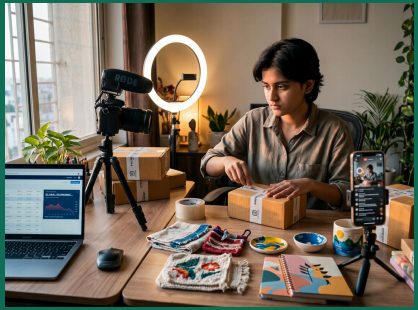
Instead of waiting to find out, we adapted. Side hustles but this time with more resources. And this time we saw the possibility no one had considered. We looked at it not as a contingency plan but as a first choice. What started as a survival tactic quietly became something else. Gen Z has produced a wave of entrepreneurs, creators, and independent professionals that is too large and too deliberate to be dismissed as a trend. The Instagram store, the design studio run from a one-bedroom apartment, the YouTube channel that pays more than the job that inspired it - they are the result of a generation that was handed an unreliable promise and decided to write its own instead. This transition is not purely financial. It is the autonomy that comes with it - the flexible hours, the creative agency, the simple dignity of building something that belongs to you. Not everyone will make it as an entrepreneur or a content creator. That is true. But not everyone makes it to the corner office either. At least one of those paths does not require thirty years of your life as the entry fee.
This is not a rejection of ambition. If anything, it is ambition taken more seriously than any employer expected. We simply redirected it - toward work we could own, income we could control, and futures that did not depend entirely on whether a company decided to retain us through the next restructuring cycle.
List of Comments
Leave a Comment