
HR TECH : Employee Listening Technologies and Sentiment Analysis
How a Global Tech Firm Transformed Engagement Through Listening
When a 40,000-employee global technology company noticed rising attrition and declining morale across its engineering teams, traditional HR dashboards offered no early warning. Productivity looked stable, and exit interviews revealed little beyond generic reasons for leaving. Sensing a deeper cultural issue, the company implemented an always-on employee listening platform integrated with Microsoft Teams.
Within eight weeks, sentiment analysis on open-text comments revealed three clear patterns: teams experiencing rapid product pivots felt excluded from decision-making, frontline managers lacked clarity during shifts in strategy, and burnout indicators were spiking in two major regions. These insights had never surfaced through annual surveys.
Armed with real-time dashboards, leaders launched targeted interventions: weekly alignment huddles, manager capability workshops, workload redistribution, and a transparent “You said, we did” communication series. Six months later, engagement scores rose by 11%, regretted attrition dropped by 18%, and time-to-market for key releases improved measurably.
This case shows that employee listening is no longer an HR ritual—it is an operational intelligence system.
Why Employee Feedback Matters
Employee feedback has become one of the most strategic assets for organizations striving to stay agile, resilient, and innovative. In fast-changing environments, listening to employees provides early signals of cultural, operational, and leadership issues that are otherwise invisible in traditional performance metrics. Effective listening builds trust, strengthens belonging, and equips leaders to act quickly on emerging needs.
Organizations grow when they learn continuously—and employees are often the first to sense challenges or opportunities. Feedback highlights blockers to productivity, identifies burnout risks, reveals inclusion gaps, and surfaces innovation from the ground up. Companies that listen well improve engagement, retention, customer satisfaction, and overall organizational agility.
What Modern Employee Listening Technologies Do
Today’s platforms have evolved far beyond annual surveys. They typically include:
- Multi-frequency surveys: engagement surveys, pulse checks, onboarding and exit surveys, and event-based listening.
- Always-on channels: chatbots, anonymous suggestion tools, mobile apps, and integrations with everyday work tools (Slack, Teams).
- AI-driven sentiment and text analytics: NLP identifies themes, classifies tone, and uncovers hidden drivers of engagement.
- Manager-level dashboards: actionable insights, heatmaps, and recommended actions aligned to team needs.
- Closed-loop feedback systems: nudges, action planning templates, and automated follow-up reminders.
Best Practices Used by Large Organizations
1. Shift from annual to continuous listening
Traditional annual surveys give leaders only a snapshot of employee sentiment, often missing emerging issues. High-performing organizations now adopt a multi-frequency listening strategy that includes quarterly engagement surveys, monthly or event-based pulse surveys, and lifecycle surveys at key moments such as onboarding, promotions, and exits. This creates a real-time feedback ecosystem where leaders can detect sentiment shifts early, track the impact of business changes, and respond proactively rather than reactively
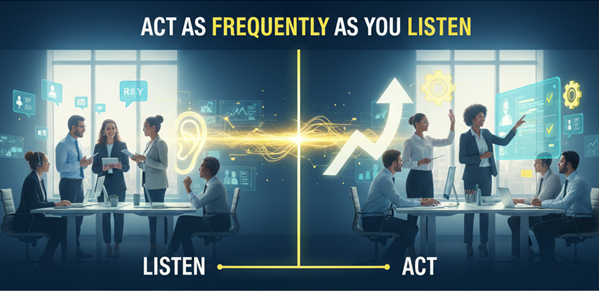
2. Act as frequently as you listen
Collecting feedback without action is one of the fastest ways to create survey fatigue and disengagement. Employees need to see tangible outcomes from their input.
Leading organizations implement “listen → analyze → act → communicate” cycles, ensuring that each survey triggers visible follow-up steps, even if the action is simply acknowledging constraints. The principle is simple: only listen as often as you can meaningfully respond. This maintains credibility and strengthens the feedback culture.
3. Empower leaders with insight—not just data
Data alone rarely drives change; actionable insight does. Modern employee-listening platforms provide managers with team-level dashboards, heatmaps, coaching tips, and guided action plans. This decentralizes ownership, enabling frontline and mid-level managers to address issues directly within their teams. Companies that succeed with listening empower leaders with context-specific recommendations—turning insights into everyday behavior change and improving accountability across the organization.
4.Protect anonymity and communicate transparently
(Please correct the spelling of transparency and anonymity in the image)
Employees will only share honest feedback when they believe their identity is safe. Organizations reinforce anonymity by setting minimum reporting thresholds, limiting access to raw comments, and clearly articulating what will—and will not—be tracked. Transparency strengthens this trust. Communicating “You said, we did” messages, sharing themes openly, and explaining how insights are used helps build a culture where employees feel heard and respected.
5. Integrating listening into transformation
Employee listening is not an HR exercise—it is a strategic capability. During restructures, culture shifts, mergers, leadership transitions, or rapid scaling, sentiment data becomes a critical indicator of readiness, resistance, and risk. Organizations that embed listening into transformation efforts use insights to shape communication plans, tailor interventions, and identify hotspots early. This leads to smoother transitions, higher adoption of change initiatives, and stronger organizational resilience.
Popular Tools Used by Organizations Today
(TO BE MADE INTO A TABLE WITH LOGOS INSERTED)
- Qualtrics Employee Experience
- Workday Employee Voice
- Microsoft Viva Glint
- Culture Amp
- Perceptyx
- Medallia Employee Experience
- Officevibe
- Lattice Pulse
- 15Five
- CultureMonkey
These tools help organizations move from feedback collection to continuous insight and action—making employee voice an engine for agilityand high performance.
List of Comments
Leave a Comment