
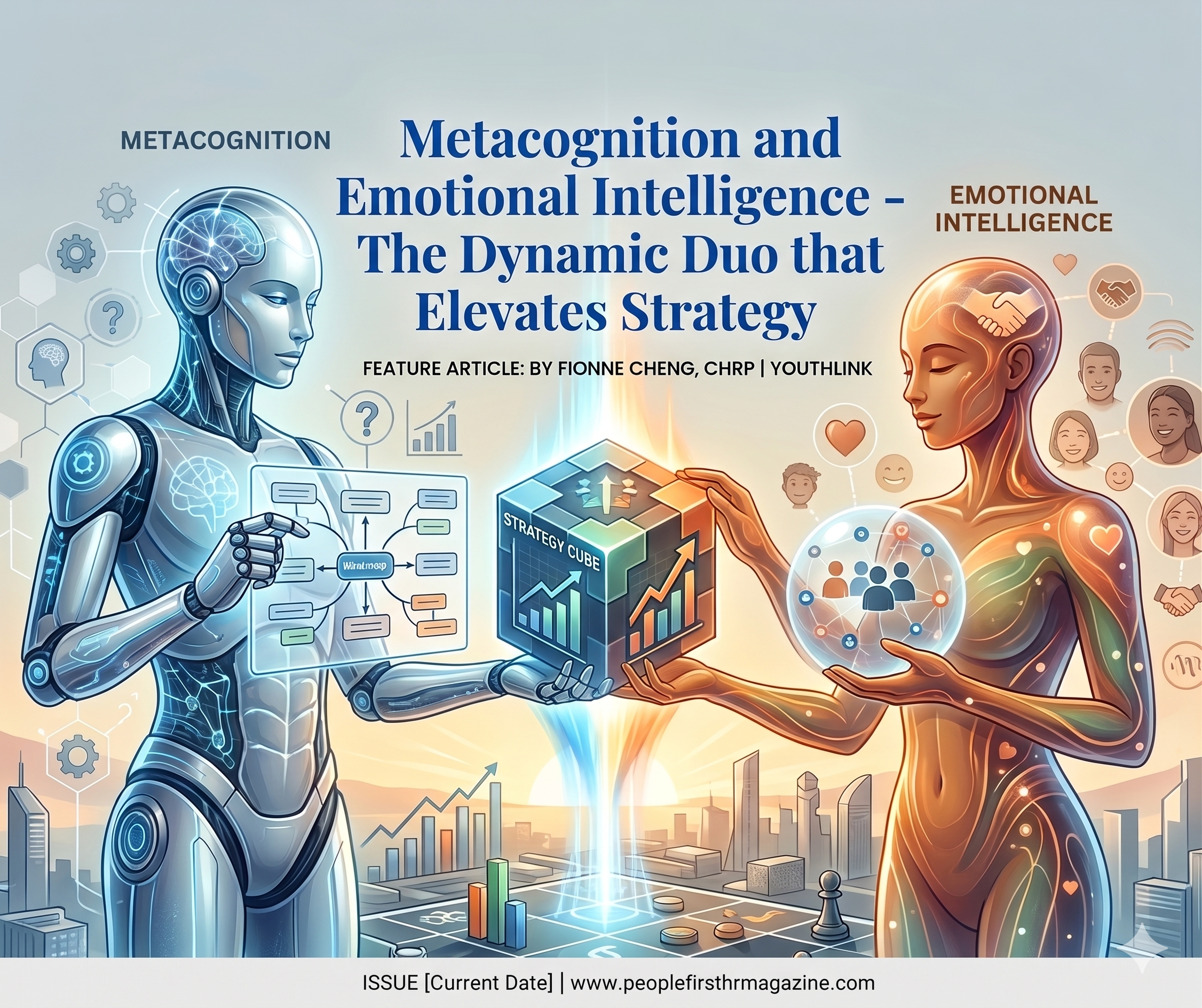
Metacognition and Emotional Intelligence - The Dynamic Duo that Elevates Strategy
Strategies don’t fail because they’re poorly designed, they fail because people executing them lack awareness of their thinking, emotions, and the social dynamics around them. For HR leaders, this means strategy is no longer supported by people practices, it is executed through them.
Metacognition is how leaders think about thinking; emotional intelligence is how people understand and manage feelings; strategy execution fails when either is missing.
Metacognition
Leadership breaks down with unexamined assumptions.
Metacognition is formed from two root words of Greek and Latin origin: meta meaning “about” or “beyond” and cognoscere meaning “to know” or “to get to know”. Together, the term implies, “thinking about thinking,” but it goes beyond that. Metacognition is a form of higher-level thinking - the awareness and control of your own mental processes during learning. In essence, it involves two core components: knowledge and regulation.
Metacognitive Knowledge: What you know about your thinking
This refers to the knowledge you have to monitor, control, and guide your thinking. It is divided into three parts: person, task, and strategy.
- Person: Knowledge about yourself and others as learners—how you think, learn, and process information.
Ex. If you are training children, you’d consider pedagogy over andragogy.
- Task: Knowledge about the nature of a task and the type of thinking or effort it requires.
Ex: Studying for an exam will require more time and mental load than reading graphic novels.
- Strategy: Knowledge of methods, techniques, or approaches and knowing when to use them to achieve successful learning.
Ex. You may “teach” classmates as a way to study for a test to engage in higher-level processing.
Metacognitive Regulation: How you regulate your thinking
This is where awareness turns into control, and insight into action. It involves a continuous feedback loop of monitoring, controlling, and guiding your thinking to solidify learning and to gain deeper understanding.
In strategy, metacognition may help leaders recognize flawed assumptions, adjust thinking under pressure, and course-correct before small errors become systemic failures.
Emotional Intelligence (EI)
Emotional Intelligence is the ability to recognize & articulate emotions, comprehend their significance, and effectively regulate them to promote self-development (Chen, Chen, & Chu, 2024, p. 548). In Greaves Jean and Travis Bradberry’s book, Emotional Intelligence 2.0, emotional intelligence is grouped into two core competencies: Personal and Social, each further divided into two subdivisions: self-awareness, self-management, social awareness, and relationship management.
- Self-Awareness: The ability to recognize and understand your own emotions as they occur and how they influence your thoughts, behaviours, and decisions.
- Self-Management: The ability to regulate and respond to your emotions thoughtfully rather than reacting impulsively.
- Social Awareness: The ability to recognize and understand others’ emotions as they occur.
- Relationship Management: The ability to regulate and respond effectively to others’ emotions.
Together, these four areas shape your internal world (how you perceive, interpret, and manage your own emotions) and your interpretation of the external world. They effectively shape how you experience, interpret, and interact with the world, influencing your decisions, relationships, and overall approach to life.
On their own, metacognition and EI improve learning and relationships. Together, they determine whether strategy survives contact with reality. But strategy doesn’t live on paper, it lives through people. And people think, feel, and react long before the execution.
Where Metacognition and EI Converge
Humans are social by nature, and most of our success in social interactions can be attributed to social coherence—our ability to align with shared expectations, norms, and emotional cues. This is why technically sound strategies can fail during change initiatives, because the social system meant to support it, actively rejects it. As metacognition develops across the core EI competencies, we gain a deeper understanding of how we can influence our external world, specifically when it comes to relationship management.
When working with various individuals—whether in personal or professional contexts— understanding how to navigate emotions, ensuring your message is clearly articulated and understood, and persuading others that your approach is both logical and effective is a delicate art that requires constant, meticulous fine-tuning.
Success in strategy formation and execution depends on metacognition paired with emotional intelligence. Together, these two skills can help elevate strategic thinking and decision-making, enabling more effective interactions and outcomes. By understanding both our own thought processes and emotional cues, we can craft strategies that are flexible, socially aware, and effective.
How the Duo Shows Up in Strategy
Successful outcomes depend on the execution. Because strategy is dynamic, individuals must remain agile and adaptable. Metacognition and EI give you both the self-awareness and social acumen needed to plan, execute, and adjust effectively, turning strategic intentions into successful outcomes.
Metacognition and Strategy:
Metacognition provides the internal framework and attunement needed for strategic implementation.
- Planning: Identifying challenges, resources, and steps necessary to achieve the desired solution.
- Acting: Executing the strategic plan.
- Monitoring: Continuous progress tracking and assessing whether the strategy continues to be effective, pivoting as necessary.
These steps form a continuous loop where action reveals information and monitoring informs adjustment.
EI and Strategy:
Emotional intelligence provides the social and emotional framework needed to execute strategy effectively.
- Self-Awareness: Understanding your emotional responses helps in recognizing when personal biases, stress, or assumptions may be influencing decisions around talent, performance, or organizational change.
- With metacognition, you can assess whether thinking aligns with broader workforce strategy. For example, distinguishing between a discomfort with change vs a risk to culture or compliance.
- Self-Management: Regulating emotions enables you to respond thoughtfully during high-stakes situations such as employee relations issues, layoffs, or conflict resolution, rather than reacting defensively or emotionally.
- With metacognition, you can intentionally adjust your communication style and decision-making approach, balancing empathy with policy, and ensuring consistency and fairness across the organization.
- Social Awareness: Recognizing and interpreting the emotions of employees, leaders, and teams allows you to anticipate resistance, morale shifts, or engagement risks during initiatives like restructures, performance cycles, or DEI efforts.
- With metacognition, you can assess whether concerns stem from misalignment, unmet needs, or competing priorities—enabling strategic adjustments that address root causes rather than surface reactions.
- Relationship Management: Effectively responding to others’ emotions builds trust, psychological safety, and credibility—critical for influencing others, supporting managers, and fostering employee buy-in during change.
- With metacognition, you can reflect on interpersonal dynamics, refine influence strategies, and intentionally strengthen partnerships, ensuring relationships remain productive while driving organizational
Insight to Execution
After establishing an objective, it is important to formulate a strategic plan and to achieve it within a specified timeline. If strategy is where thinking meets action, then execution is where cognition and emotions collide. The following framework shows how to manage both deliberately.
| Step | Metacognition Focus | Emotional Intelligence Focus |
| Planning | Person: Identify your strengths, weaknesses, and learning style to approach the task effectively.
Task: Understand the nature of the task and what it requires.
Strategy: Determine methods, resources, and steps needed to achieve success.
Regulation: Decide how to manage your thinking, attention, and approach to plan effectively. | Self-Awareness: Recognize your emotions and motivations to align decisions with your goals.
Self-Management: Prepare to manage emotional responses during execution.
Social Awareness: Anticipate reactions of others involved.
Relationship Management: Plan how to communicate and collaborate effectively. |
| Acting | Person: Track how your thinking and behavior influence progress.
Task: Continuously evaluate task demands and adjust effort.
Strategy: Assess whether current methods are effective or need modification.
Regulation: Monitor your cognitive processes, notice biases or errors, and adjust thinking as needed.
| Self-Awareness: Notice emotional triggers that might affect performance.
Self-Management: Stay focused, control impulses, and respond appropriately.
Social Awareness: Observe others’ reactions to your actions.
Relationship Management: Adapt interactions to maintain trust and collaboration. |
| Monitoring | Person: Reflect on personal insights and adapt approach.
Task: Modify how you handle the task based on feedback.
Strategy: Change strategies or methods to improve outcomes.
Regulation: Implement changes based on reflection and feedback to make informed, effective decisions. | Self-Awareness: Evaluate how emotions influenced decisions and adjust accordingly.
Self-Management: Regulate emotions to implement changes smoothly.
Social Awareness: Reassess others’ perspectives to improve alignment.
Relationship Management: Refine communication and influence to sustain relationships while executing the revised strategy. |
What differentiates high-performing strategists is not better plans, but better relationship management; when people see you genuinely care and act to support them, they commit more fully to the shared mission and vision.
In a world being completely rewritten by Artificial Intelligence, effective leadership will depend less on technical mastery and more on people attunement; the ability to think clearly, regulate emotions, and navigate human systems with clarity and purpose. Organizations that fail to cultivate the metacognitive and emotional awareness needed to recognize this shift—and adapt accordingly—risk prioritizing immediate gains over long-term impact. While AI works diligently to rewrite the rules, leaders still win (or lose) based on how well they understand, communicate with, and lead people.
As AI rewrites the world, what will you do to keep your people, and strategy, alive?
About the Author:
Born in Hong Kong and based in Toronto, Canada, Fionne Cheng is a human connector, HR leader, and mindfulness-focused facilitator dedicated to helping people reconnect with themselves, others, and their potential. With 9 years of HR experience, she specializes in training, onboarding, documentation, and process design, building people-centred systems that enable growth and psychological safety.
Beyond her HR career, Fionne is a workshop facilitator, coach, and mindfulness advocate, integrating breathing meditation, creativity, emotional regulation, and trauma-informed tools into transformative learning experiences. Her work has earned recognition across organizations, including a DEI nomination, multiple awards, and media coverage. She holds an Honours double major in Visual Arts and Psychology, postgraduate certificates in Human Resources Management and Adult and Continuing Education, and is pursuing her Master’s in Leadership. Guided by a philosophy of psychological safety, introspection, self-improvement, authenticity, and service, she inspires others to become leaders in their own right.
List of Comments
Leave a Comment