
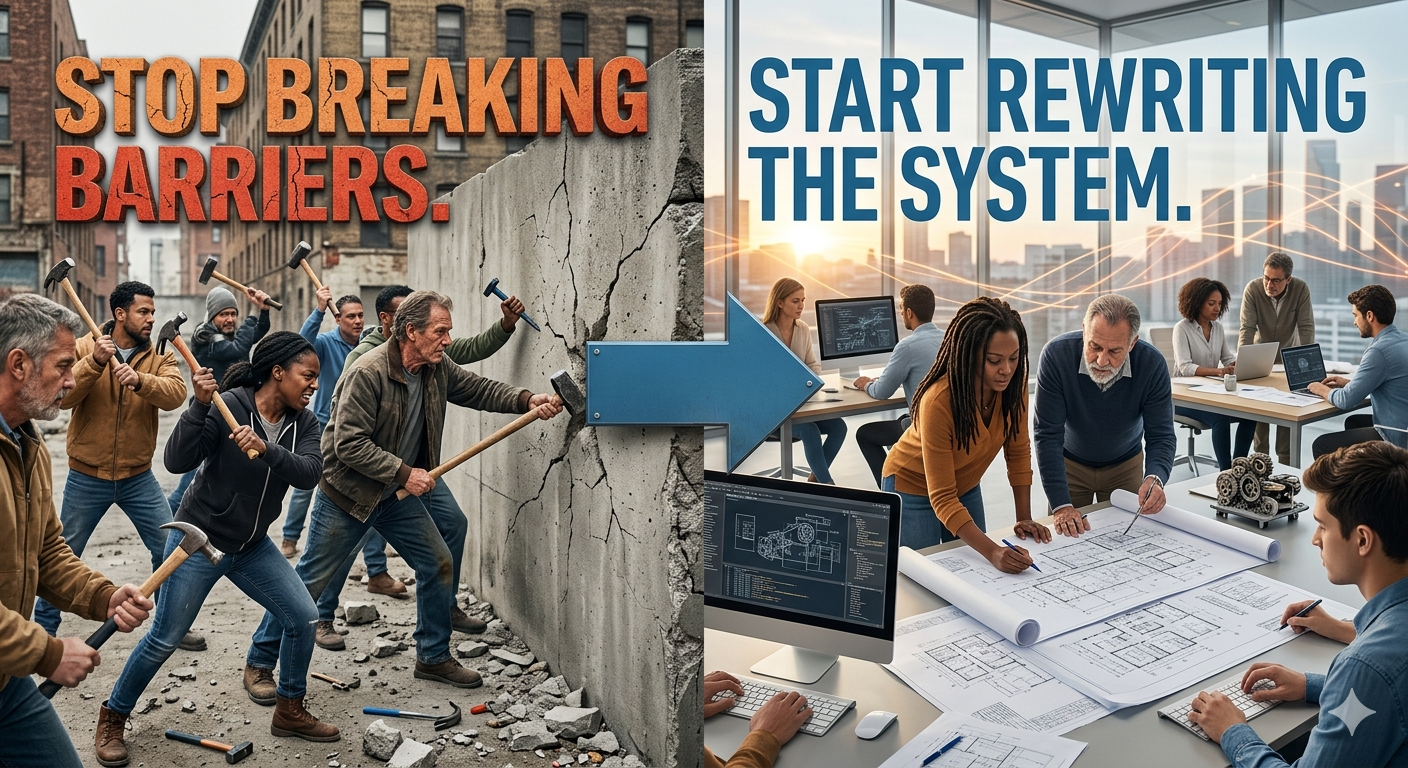
Stop Breaking Barriers. Start Rewriting the System
For decades, the narrative of women in leadership centred on breaking barriers — glass ceilings shattered, biases challenged, doors opened where none existed before. These stories matter. They reflect courage and resilience.
But in 2026, the conversation must evolve.
Breaking barriers changes moments.
Building systems changes institutions.
Now it calls for a shift in focus — from celebrating individual advancement to examining structural impact. And nowhere is this transition more visible than in the evolution of women leaders in Human Resources.
“Breaking a barrier changes a moment. Building a system changes a generation.”
Across industries, women in HR are moving beyond representation toward reinvention. They are not only advancing into leadership roles — they are redesigning the architecture of work itself.
From Representation to Structural Reinvention
While women form a significant proportion of the global HR workforce, leadership parity across industries remains uneven. The World Economic Forum’s Global Gender Gap Report 2024 estimates that, at the current pace, full gender parity globally remains more than a century away. The implication is sobering: visibility alone does not guarantee velocity.
What differentiates the current moment is not simply who occupies leadership roles — but how those roles are being redefined.
Three structural shifts are shaping this transformation.
Inclusion as Infrastructure
Organisations are moving beyond diversity hiring targets toward embedding equity into operating models — transparent promotion frameworks, bias-audited performance reviews, pay equity analytics, and inclusive leadership metrics.
Inclusion is no longer a standalone initiative. It is governance.
Data-Driven Empathy
The rise of people analytics has enabled HR to move from anecdotal advocacy to evidence-based strategy. Women leaders are increasingly operating at the intersection of empathy and analytics — ensuring that data strengthens human-centred decision-making rather than replacing it.
When inclusion is measured, it becomes manageable.
When it is managed, it becomes sustainable.
Well-being as Business Strategy
Psychological safety, flexible structures, and caregiver inclusion are no longer peripheral benefits; they are linked directly to productivity and retention. McKinsey’s Women in the Workplace 2024 report notes that women leaders are significantly more likely than men to champion employee well-being, inclusive leadership behaviours, and DEI initiatives — yet this contribution often goes formally unrecognised in performance systems.
Organisations are benefiting from inclusive leadership. The next step is institutionalizing how it is valued.
“Inclusion is not a program. It is an operating model.”
The organisations thriving today are not merely promoting women into leadership — they are embedding inclusive design into how decisions are made, measured, and rewarded.
From Personal Resilience to Organisational Architecture
Resilience has long been celebrated in women’s leadership journeys. Yet resilience, while admirable, is not scalable. Systems are.
For too long, women were expected to navigate imperfect structures successfully. The real transformation begins when women move from coping within systems to redesigning them.
This shift is visible in how HR leaders are institutionalizing change:
- Replacing informal sponsorship with structured mentorship ecosystems
- Turning flexible work from exception into embedded policy
- Embedding pay transparency rather than negotiating fairness individually
- Designing return-to-work pathways for career breaks
- Aligning leadership competencies with measurable impact over mere visibility
Barrier-breaking is reactive.
System-building is strategic.
HR now sits at the centre of enterprise transformation. No longer confined to administrative oversight, the function increasingly influences workforce planning, digital transition, culture integration, and governance architecture.
“The future of leadership is not louder. It is wiser.”
HR Technology as a Structural Equalizer
Technology is accelerating this shift.
Deloitte’s Global Human Capital Trends 2025 report highlights that more than 70% of organisations are investing in AI-driven HR technologies. Yet fewer than half report having formal governance frameworks to monitor bias and ethical impact. This gap presents both risk and opportunity — and places HR leadership at the forefront of responsible innovation.
When deployed intentionally, HR technology becomes a structural equalizer.
AI-powered platforms now analyze job descriptions for biased language and prioritize skills alignment over pedigree. Digital talent marketplaces shift hiring from degree-based filtering to competency mapping, widening access to professionals from non-traditional backgrounds. Real-time pay equity dashboards and transparent career path tools reduce reliance on informal networks — networks that historically advantaged a select few.
Predictive people analytics enable leaders to identify attrition risks, mobility bottlenecks, and engagement disparities before they become systemic problems.
“Technology, when governed ethically, becomes a catalyst for equity.”
But innovation without oversight can replicate the very inequities it aims to solve. Women leaders in HR are increasingly influencing AI governance, ethical data policies, and algorithm audits — ensuring that the future of work is not only efficient, but fair.
Redefining Power in Leadership
The traditional corporate model often rewarded visibility, dominance, and individual heroics. The emerging model values influence, collaboration, and structural foresight.
HR — once seen primarily as a support function — is now central to enterprise resilience. From hybrid workforce design to ESG-aligned talent strategy, the function shapes how organisations respond to volatility.
Women in HR are driving:
- Hybrid and distributed work architecture
- Workforce reskilling amid automation
- Culture integration during mergers and acquisitions
- Leadership pipelines aligned to diversity and sustainability goals
This is not soft influence.
It is structural authority.
“Sustainable leadership is measured not by control, but by continuity.”
From Breaking Barriers to Building the Future
The evolution from barrier-breaker to system-builder is not theoretical. For many of us, it is deeply personal.
I began my professional journey in a small town, educated in local institutions and started my career in a tier-3 city with limited exposure and minimal networks. There was no accelerated pathway — only a steady commitment to learning, adapting, and building capability step by step. Over time, those early constraints became insight. They revealed a critical truth: talent is universal, but opportunity is often structural.
That understanding shaped my leadership philosophy.
Today, leading HR is not about overcoming individual obstacles. It is about ensuring that organisational systems do not create them unnecessarily for others. The real measure of leadership is not personal advancement — it is whether the structures we design expand access, transparency, and growth for those who start without advantage.
“Leadership is not defined by where you begin, but by the systems you create so others can begin better.”
The coming decade will not be defined by how many barriers women break. It will be defined by how many intelligent, inclusive systems we institutionalize — systems where hiring is skills-based, advancement is transparent, flexibility is embedded, and equity is measurable.
This is the shift from narrative to architecture.
From resilience to reinforcement.
From individual achievement to institutional transformation.
“Legacy is not the obstacle you overcame — it is the structure you built so others never face it.”
When women move from navigating systems to designing them, organisations do more than become inclusive. They become adaptive. Sustainable. Future-ready.
And that is the future we are building.
About the Author
Jaishree Gaur is a strategic HR leader and systems thinker currently serving as Senior Manager – Human Resources at Innophase IoT India Pvt. Ltd. With 9 years of cross-industry experience spanning healthcare, manufacturing, SaaS, real estate, and semiconductor, she specializes in designing people strategies that translate business vision into measurable organizational impact. Her work integrates talent architecture, succession planning, compensation strategy, change management, and performance systems to build agile, high-performance cultures.
With a foundation in Computer Science and an MBA in Human Resource, she brings analytical depth to people leadership — combining technology enablement with human-centered design. A certified POSH trainer and advocate for inclusive governance, she has led process optimization and HR system implementations that enhance compliance, transparency, and workforce equity.
Passionate about empowering individuals and strengthening institutional capability, she focuses on building sustainable systems where talent thrives and organizations evolve with purpose.
List of Comments
Leave a Comment