
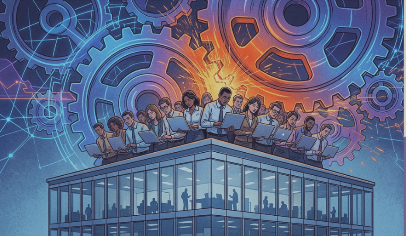
The Office Is Not the Culture.
Rethinking the Return-to-Office Debate in the Age of Change Fatigue
Somewhere between 2020 and today, the office became the most politically charged real estate in corporate history. What used to be simply the place where work happened has become a battleground a proxy war for deeper disagreements about trust, productivity, culture, and control. And right now, in 2026, as return-to-office mandates sweep through global organizations and reverberate loudly across Indian MNCs, HR leaders are standing in the crossfire.
I have been in HR for over two decades. I have built HR functions from scratch, led talent strategy for workforces of thousands, and navigated the people implications of technology disruptions, leadership transitions, and market upheavals across industries as varied as financial services, real estate, and media-technology. And I will say this plainly: the return-to-office debate, as it is currently being conducted in most organizations, is asking the wrong question.
The question is not 'how many days in the office?' The question is: 'What kind of organization are we trying to build, and what does that require from how and where people work?' Until we answer the second question with honesty and clarity, no RTO policy however firmly mandated will deliver what leadership hopes it will.
"The return-to-office debate is asking the wrong question. The real question is: what kind of organization are we trying to build?"
The Context: Why This Debate Has Intensified in 2026
The return-to-office wave of 2026 is not happening in isolation. It is the product of several converging pressures. Real estate portfolios that organizations locked in before the pandemic sit underutilized and expensive. CEOs, under pressure to demonstrate growth and efficiency, are equating physical presence with productivity a conflation that research consistently challenges, but which has an intuitive appeal in boardrooms where visibility has always been currency.
Globally, data from over 400 CHROs surveyed by Gartner reveals that addressing talent and change fatigue is among the top HR priorities of 2026. And yet, the very mandates being issued in the name of culture-building are, in many organizations, accelerating exactly the fatigue they claim to cure. Employees who spent years adapting to remote work, to hybrid work, to restructurings, to AI-driven role changes are now being asked to adapt again. And this time, the ask feels less like organizational evolution and more like regression.
In India, the dynamic has its own texture. Our workforce culture has traditionally placed high value on in-person relationship building and hierarchical visibility. But five years of demonstrated productivity in distributed environments, combined with infrastructure improvements and a generation of talent that entered the workforce during the hybrid era, has permanently altered expectations. The India of 2026 is not the India of 2019. HR leaders who approach RTO with pre-pandemic assumptions will find themselves managing exits, not engagement.
What the Data Actually Says : and What Leaders Hear Instead
The evidence on hybrid versus in-person work is more nuanced than either side of the debate typically acknowledges. There is genuine research supporting the value of in-person collaboration for specific kinds of work complex problem solving, creative ideation, onboarding, mentorship, and relationship building, particularly for early-career employees. These are real and important benefits, and HR leaders would be remiss to dismiss them.
But the same body of evidence does not support the proposition that full-time office attendance uniformly drives productivity, innovation, or engagement. In fact, for deep individual work analysis, writing, coding, strategic thinking research consistently shows that focused, distraction-free environments (which for many people means home) outperform open-plan offices.
The honest truth is that productivity is not primarily a location problem. It is a clarity problem, a management problem, and in many cases, a culture problem. Organizations that struggled with accountability and output in a hybrid model did not struggle because people were working from home. They struggled because they had never built the management infrastructure, the goal-setting rigour, and the trust-based culture that effective distributed work requires. Moving everyone back to the office does not fix those problems. It just makes them less visible for a while.
"Productivity is not primarily a location problem. It is a clarity problem, a management problem, and a culture problem."
The Change Fatigue Factor -The Variable Everyone Is Underweighting
Here is what concerns me most as an HR leader watching the current wave of RTO mandates: we are adding new disruption on top of a workforce that has not fully recovered from the last several rounds of disruption.
The concept of change fatigue is well-documented, but its true organisational cost is systematically underestimated. Change fatigue is not employees being lazy or resistant to growth. It is the very human physiological and psychological consequence of sustained uncertainty and adaptation. And it is cumulative. Each major change in remote work adoption, hybrid transitions, restructurings, technology implementations, leadership changes depletes a finite reserve of adaptive capacity. When that reserve is exhausted, performance drops, creativity narrows, attrition rises, and the next change initiative however well-designed lands on soil that cannot sustain it.
Gartner's 2026 research shows that organizations that routinely change rather than repeatedly shock people with it see three times higher healthy change adoption. The implications for RTO are direct: if you are going to bring people back, do it in a way that is thoughtful, gradual, and genuinely explained. Not as a mandate, but as a movement one that people can see the logic of, contribute to, and trust.
What Good RTO Leadership Actually Looks Like
In my experience leading large, complex HR functions, I have found that the most effective approaches to workplace design share three characteristics that most RTO mandates currently lack.
The first is genuine business rationale, communicated with honesty. 'I believe in-person collaboration drives innovation' is a legitimate position if it is true for your business and backed by evidence specific to your work types and teams. But 'we want people in the office because we are paying for the space' or 'our CEO feels more comfortable seeing activity' are not reasons that will survive contact with an engaged, intelligent workforce. People tolerate inconvenience for reasons they believe in. They resist it fiercely when they sense they are being managed rather than led.
The second is differentiation by role and function. The idea that every role in an organization requires the same physical attendance profile is indefensible given what we now know about the nature of work. A client-facing relationship manager and a data scientist have fundamentally different work patterns, output metrics, and collaboration needs. A thoughtful HR strategy acknowledges this and designs workplace policies that reflect it not as special exceptions, but as the intelligent default.
The third is genuine investment in making the office worth coming to. If you are asking people to trade a daily commute, a more flexible schedule, and a quieter work environment for an open-plan office with inadequate meeting rooms and back-to-back video calls that they could have taken from home, you are not building culture. You are building resentment. The physical office in 2026 must be a purposefully designed environment for connection, collaboration, and the kinds of work that genuinely benefit from proximity. If it is not that, the mandate is an imposition, not an invitation.
"The office in 2026 must be worth coming to. If it isn't, the mandate is an imposition, not an invitation."
The Real Work: Building Culture That Does Not Depend on a Postcode
The deepest flaw in the RTO-as-culture-fix argument is the assumption it rests on that culture lives in a building. It does not. Culture lives in behaviours, decisions, rituals, language, and leadership. It lives in how managers respond when someone makes a mistake. It lives in whether recognition is genuine or performative. It lives in whether values are referenced in difficult decisions or only in onboarding slides.
I have worked in organizations where the culture was vivid, warm, and unmistakable even when teams were distributed across three time zones. And I have worked in organizations where people sat ten feet apart for eight hours a day and experienced no meaningful sense of belonging or shared purpose. The difference was never the location. It was always the leadership.
The HR function's role in this moment is not to arbitrate the RTO debate. It is to do the harder, more important work: to help organizations build cultures that are strong enough to sustain distributed work, and clear enough in their values that physical presence becomes a choice made willingly because people want to be together rather than a compliance requirement enforced reluctantly.
A Practical Framework for HR Leaders Navigating This Right Now
For HR leaders currently wrestling with RTO policy design or facing pushback on existing mandates, I offer a framework built from lived experience rather than theory.
Start with an honest culture diagnostic, not a blanket policy. Understand what specific cultural or collaborative outcomes you are trying to achieve, and which of them genuinely require in-person interaction. This tells you what to mandate and what to leave flexible and it gives you a rationale that employees can respect.
Measure outcomes, not attendance. If you are tracking swipe-card data and seating utilization to assess whether RTO is 'working,' you are measuring the wrong things. Measure what you actually care about: project velocity, team cohesion scores, innovation output, attrition rates, and engagement indices. These tell you whether your workplace model is serving your organisation. Attendance tells you only whether people are showing up not whether they are thriving.
Invest in your managers before issuing your mandates. The quality of the immediate manager is the single most powerful determinant of employee experience in any work model. Before you ask people to give up flexibility, make sure their managers are equipped to make the trade worth it. A great manager makes coming to the office energizing. A poor one makes it demoralizing, regardless of how nice the cafeteria is.
And finally, listen genuinely, not performatively. The organizations that will navigate this era of change fatigue most effectively will be those that treat their people as intelligent adults who have earned the right to be part of decisions that affect them. Consultation is not capitulation. It is the foundation of the trust that makes every subsequent change easier to carry.
The Bottom Line
The return-to-office debate is, at its core, a debate about trust, purpose, and what kind of organisations we want to build in a world that has been permanently altered. HR leaders have a choice: we can be the architects of thoughtful, human-centred workplace design or we can be the administrators of mandates that management has already decided. The first role is harder. It requires courage, data, and the willingness to push back when a policy is being driven by instinct rather than evidence. But it is the only role that will actually serve our organisations and our people well.
The office is not the culture. The culture is the culture. And building it is the most important work any of us will do.
List of Comments
Leave a Comment