
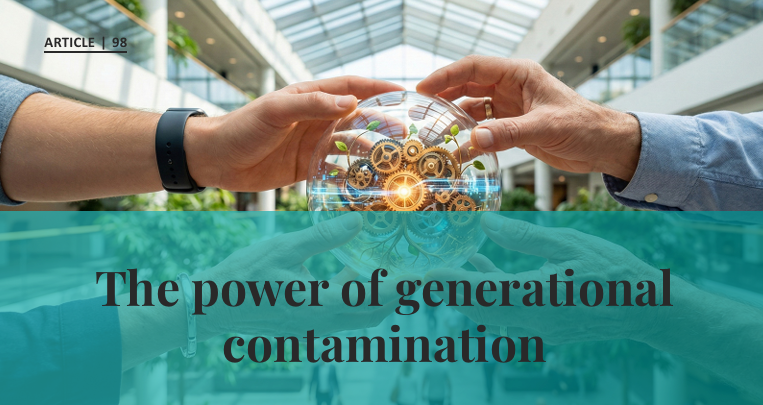
The Power of Generational Contamination
Organisations have never been as multigenerational as they are today. Four, sometimes five generations share the same corridors, platforms, and meeting rooms, bringing radically different relationships with work, technology, and authority. This coexistence can generate misunderstanding and friction, but it can also become a powerful engine of innovation if consciously cultivated.
The concept of “generational contamination” captures this opportunity. Instead of treating generational gaps as a problem to be solved, it views the exchange of languages, habits, and expectations between generations as a dynamic flow of learning. In a multigenerational workplace, a senior manager can transfer strategic judgment and institutional memory, while a Gen Z or future Gen Alpha colleague introduces new digital practices, collaborative norms, and cultural sensitivities. The result, when orchestrated well, is not a compromise at the lowest common denominator, but a richer and more adaptive culture.
For HR and leadership development functions, this means shifting the focus from “managing differences” to “activating cross-generational value”. The arrival of Generation Alpha over the next decade will stress-test this capability.
Who Generation Alpha will be at work
Generation Alpha is generally defined as those born from around 2010 onward, the first cohort to grow up fully immersed in smartphones, AI, and on-demand content from early childhood. They will enter the workforce gradually from the second half of the 2020s, initially as interns, apprentices, and junior professionals.
Some research and early indicators from education and youth studies suggest several traits that will shape their expectations at work:
- High digital immersion: They are “AI natives”, accustomed to intuitive interfaces, automation, and continuous connectivity.
- Preference for personalized experiences: From learning to entertainment, they expect tailored pathways rather than standard one-size-fits-all programs.
- Strong sensitivity to purpose and impact: They look for alignment between their personal values and employers' social, environmental, and ethical stances.
- Demand for psychological safety and wellbeing: Mental health, flexibility, and supportive environments are seen as non-negotiable, not as extra benefits.
- Short feedback loops: Accustomed to instant interactions, they value frequent, clear, and constructive feedback more than annual performance rituals.
Leaders who grew up in analog or early-digital contexts may find these expectations demanding or unfamiliar. The role of HR is to anticipate the gap and design development paths that prepare them to respond without defensiveness or nostalgia.
What new leaders will need to change
The core leadership capabilities required for Generation Alpha are not entirely new, but the intensity and combination of these capabilities will be different. HR functions can start from at least four pivotal shifts, evidenced across contemporary analyses of Gen Alpha and multigenerational workforces.
- From control to trust and autonomy. Traditional management models, based on presence, direct supervision, and standardized processes, will be less effective with Gen Alpha. They expect autonomy, flexibility in how and where work is done, and the possibility to experiment with new tools and methods. Leaders must learn to define clear outcomes while leaving room for different paths to reach them, using data and transparent goals instead of micro-control.
- From technical authority to relational credibility. Younger generations tend to question formal hierarchies and respond more to authenticity, coherence, and relational skills. For Gen Alpha, a credible leader is one who listens, admits mistakes, and is willing to be challenged by junior colleagues, not just the person with the highest title. This requires developing emotional intelligence, inclusive communication, and the ability to host difficult conversations across generational and cultural differences.
- From episodic feedback to continuous dialogue. Performance management at annual or semi-annual intervals is misaligned with Gen Alpha’s need for fast learning and continuous calibration. Leaders will need to integrate micro-feedback into everyday interactions, using digital tools for real-time check-ins and brief development conversations linked to concrete tasks. HR can support this shift by redesigning evaluation systems and training managers in coaching-oriented practices.
- From generic development to learning ecosystems. Gen Alpha is used to learning via videos, platforms, social communities, and hands-on experimentation. Leadership will need to curate a learning ecosystem where formal training is only one component, complemented by peer learning, reverse mentoring, stretch assignments, and project-based experiences. HR has the task of integrating these elements into coherent journeys, making development visible and accessible.
How HR can prepare leadership for Generation Alpha
To move from principles to practice, HR can act on three levels: culture, systems, and concrete development programs. Several recent analyses on Gen Alpha and future workforce trends converge on the importance of acting in a coordinated way.
1. Reframe culture around cross-generational learning
HR can position generational contamination as a core cultural asset rather than a risk.
- Promote mutual respect: Make visible the value of each generation, from the strategic experience of older workers to the digital and cultural fluency of younger ones.
- Institutionalize reverse and cross-mentoring: Pair senior leaders with Gen Z and, later, Gen Alpha talent to exchange insights on technology, new work practices, and emerging social expectations.
- Celebrate cross-age successes: Share stories where a multigenerational team has solved a problem or innovated a process, reinforcing the narrative that age diversity is a driver of performance, not an obstacle.
This cultural groundwork will make it easier for future leaders to see Gen Alpha not as “difficult” but as a natural evolution of the workforce.
2. Redesign HR systems with Gen Alpha in mind
Processes designed for previous generations may appear slow, opaque, or unengaging to Gen Alpha. HR can gradually align systems with their expectations while keeping fairness and rigor.
- Recruitment and employer branding: Highlight purpose, flexibility, wellbeing, and learning opportunities, not only compensation and stability.
- Performance and feedback: Introduce tools and rituals that enable frequent, bidirectional feedback, and encourage leaders to ask for feedback from younger team members as well.
- Career paths: Offer modular career choices, project-based growth, and lateral moves that allow Gen Alpha to build a portfolio of skills rather than a strictly linear progression.
These adjustments will also benefit other generations, making HR systems more agile and inclusive overall.
3. Design leadership development specifically for a Gen Alpha context
Leadership programs often remain generic; preparing for Gen Alpha requires more explicit focus.
- Content: Integrate modules on digital culture, social media literacies, AI and data ethics, mental health, and inclusive leadership across generations.
- Methods: Use blended experiences—simulation, role-playing with younger employees, co-design with Gen Z/Alpha representatives—to expose future leaders to real expectations and scenarios.
- Metrics: Measure not only traditional KPIs (turnover, performance) but also indicators of psychological safety, cross-generational collaboration, and the engagement of younger cohorts.
Involving promising Gen Alpha talent early in these programs, even as observers or co-facilitators, can accelerate mutual understanding and signal that their voice matters.
From coexistence to co-creation
Over the next decade, Organisations will host Baby Boomers in advisory roles, Generation X in senior positions, Millennials and Gen Z in core leadership pipelines, and the emerging Generation Alpha in new, hybrid roles at the intersection of technology, creativity, and execution. The challenge for HR is not simply to ensure peaceful coexistence, but to enable genuine co-creation among these cohorts.
Generational contamination becomes, in this sense, a deliberate leadership agenda. When HR helps new leaders read generational codes, listen to emerging expectations, and redesign their practices around trust, dialogue, and shared purpose, the arrival of Gen Alpha ceases to be a source of anxiety. It becomes an opportunity to renew the social contract of work. Preparing leaders today is the most concrete way to build a workplace where every generation—Alpha included—can both learn and leave a lasting mark.
About the Author:
Adriano Caponetto is Group Chief Human Resources at SIAE Microelettronica, where he leads global people strategy, organizational governance, and enterprise-wide transformation. With more than twentys-five years of international experience, he advises boards and executive teams on restructuring, organizational design, and long-term capability building across complex, multinational environments.
He is recognized for architecting modular organizational models, steering high-stakes transformation programs, and aligning culture, leadership, and performance to strategic intent. His approach blends analytical precision with a deep understanding of organizational dynamics, enabling companies to navigate disruption, accelerate decision-making, and strengthen competitive resilience.
A frequent contributor to HR and leadership forums, Adriano brings a forward-looking perspective on the evolving nature of work and the role of Organisations as communities that generate meaning, memory, and sustainable impact. His leadership consistently elevates HR to a board-relevant, value-creating discipline.
List of Comments
Leave a Comment