
Transformation of Urban Transport in India: A Decade of Real Change
Over the past decade, India’s urban transport story has shifted from one of daily struggle to one of visible, measurable progress. Not long ago, commuting in most Indian cities meant overcrowded buses, fragmented systems, unpredictable travel times, and heavy dependence on private vehicles. Metro rail systems were limited to a few cities, digital ticketing was rare, and long queues at ticket counters and toll plazas were simply accepted as part of everyday life.
Today, that picture is changing—and changing decisively. What we are witnessing is not just incremental improvement, but a structural transformation in how Indian cities move, connect, and grow.
The Rise of Reliable Public Transport
At the heart of this transformation lies the rapid expansion of metro rail networks. Systems like Delhi Metro, Mumbai Metro, Bengaluru Metro, and Hyderabad Metro have fundamentally changed commuting patterns in their respective cities.
Metro rail has introduced predictability into urban travel—something that was historically missing. Fixed schedules, dedicated corridors, and minimal exposure to road congestion have made commute times more reliable. In addition, improvements in safety, cleanliness, and comfort have elevated the commuter experience.
Importantly, metro systems are no longer standalone projects. They are shaping urban development itself. Transit-oriented development (TOD) is gradually taking root, with residential and commercial growth clustering around metro corridors. This reduces travel demand, shortens commute distances, and encourages public transport usage.
Public transport, once perceived as a fallback option, is now becoming the first choice for millions.
A Greener Way to Move
Sustainability is a defining feature of this transformation. Urban transport has historically been a major contributor to pollution and carbon emissions in Indian cities. The shift toward electrified mass transit is helping address this challenge.
Metro systems are significantly more energy-efficient per passenger-kilometer compared to private vehicles. Many Indian metros are adopting advanced technologies such as regenerative braking, which recovers energy during train deceleration. Additionally, renewable energy integration—such as solar power installations on stations and depots—is becoming increasingly common.
Globally, cities like Copenhagen and Amsterdam have demonstrated how sustainable mobility—through cycling infrastructure and clean public transport—can drastically improve urban air quality. India is beginning to move in a similar direction, albeit with its own unique constraints and scale.
The long-term impact is clear: reduced emissions, lower fossil fuel dependence, and healthier urban environments
Beyond Rail: Building a Connected Ecosystem
India’s mobility transformation extends well beyond metro rail. Investments in highways, expressways, and urban road infrastructure have significantly improved connectivity.
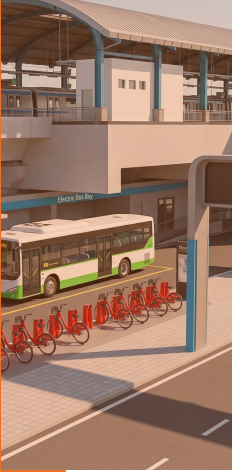
Projects like the expansion of national highways and the development of expressways have reduced travel times between cities, enabling smoother intercity movement. At the same time, urban initiatives such as bus rapid transit systems (BRTS) and electric bus deployments are strengthening intra-city connectivity.
One of the most impactful changes has been the introduction of FASTag. By enabling electronic toll collection, FASTag has eliminated long queues at toll plazas, reduced fuel wastage, and improved traffic flow. While seemingly small, such interventions have a massive cumulative effect on efficiency and commuter experience.
The Digital Revolution in Mobility
Perhaps the most transformative shift has been digital integration. The rise of digital payments and mobile technology has fundamentally changed how people interact with transport systems.
QR-based ticketing, mobile wallets, and smart cards have simplified access to public transport. The National Common Mobility Card (NCMC) is a major step toward interoperability, allowing a single card to be used across different transport modes and even retail payments.
Globally, cities like London have set benchmarks with systems like contactless payments and the Oyster card, while Singapore has demonstrated seamless integration through its EZ-Link system. India is rapidly catching up, leveraging its strong digital payments ecosystem to leapfrog traditional barriers.
The result is a frictionless commuting experience—shorter queues, faster access, and greater convenience.
Kochi: A Model for Integrated Mobility
Among Indian cities, Kochi stands out as a leading example of integrated urban mobility.
The Kochi Metro is not just a metro system—it is the backbone of a broader, multimodal transport ecosystem. It is complemented by feeder buses, auto-rickshaws, and last-mile connectivity solutions, ensuring commuters can complete their journeys seamlessly.
What truly sets Kochi apart is the Kochi Water Metro. This innovative system connects island communities using electric ferries, reducing reliance on road transport and easing congestion. It is a rare example of effectively integrating water transport into an urban mobility framework.
This multimodal approach addresses one of the biggest challenges in Indian cities: last-mile connectivity.
Seamless Travel Through Digital Integration
Kochi’s success is also rooted in its unified payment ecosystem. The Kochi1 card enables commuters to use a single payment method across metro, water metro, and feeder services. It also extends to retail transactions, enhancing usability.
Mobile applications further streamline the experience through journey planning, QR-based ticketing, and real-time updates. This integration eliminates friction points—no multiple tickets, no confusion, and no wasted time.
Globally, integrated ticketing systems in cities like Tokyo (Suica/PASMO cards) and Hong Kong (Octopus card) have demonstrated how powerful unified payment systems can be. Kochi is effectively bringing similar principles into the Indian context.
Infrastructure That Works Together
A key feature of modern urban transport is physical integration. Kochi’s mobility hubs—such as Vyttila—bring together metro rail, buses, water transport, and intermediate public transport into a single location.
Sustainability is also embedded in infrastructure planning. The presence of Cochin International Airport, the world’s first fully solar-powered airport, reflects the region’s commitment to green initiatives. Combined with electric mobility and water-based transport, Kochi is building a future-ready ecosystem.
Learning from Global Best Practices
India’s progress is significant, but global examples provide valuable lessons:
- Integrated Planning (Singapore): Singapore demonstrates how strong institutional coordination can deliver seamless multimodal transport. Land use and transport planning are tightly aligned.
- Public Transport Dominance (Tokyo): Tokyo shows how high-frequency, reliable rail networks can become the backbone of urban mobility, minimizing dependence on private vehicles.
- Cycling Infrastructure (Copenhagen): Copenhagen has prioritized non-motorized transport, proving that safe cycling infrastructure can significantly reduce congestion and emissions.
- Congestion Pricing (London): London has implemented congestion charges to discourage private vehicle use in city centers, improving traffic flow and air quality.
- Data-Driven Mobility (Barcelona): Barcelona uses smart city technologies and real-time data to optimize transport systems and enhance commuter experience.
India is increasingly incorporating these practices—whether through TOD policies, smart city initiatives, or digital integration.
Policy and the Road Ahead
This transformation has not happened in isolation. It has been guided by consistent policy direction from the Ministry of Housing and Urban Affairs, which has emphasized integrated, sustainable, and technology-driven mobility.
Programs like Smart Cities Mission, AMRUT, and metro rail policies have provided both funding and strategic direction.
Looking ahead, several innovations are poised to further reshape urban transport:
- Account-based ticketing (linking travel directly to bank accounts)
- Expansion of electric vehicles and charging infrastructure
- Mobility-as-a-Service (MaaS) platforms integrating multiple transport modes
- Use of AI and data analytics for traffic and demand management
- Greater focus on non-motorized transport (walking and cycling)
The challenge will be scaling these solutions across diverse cities with varying needs and constraints.
A Blueprint for the Future
Kochi offers a compelling blueprint for India’s urban transport future. Its success lies not in any single project, but in the integration of infrastructure, technology, and policy.
When metro systems connect seamlessly with buses, water transport, and last-mile solutions—and when all of this is tied together through unified digital platforms—the result is a system that is efficient, sustainable, and commuter-centric.
A decade ago, commuting in India was defined by inconvenience and uncertainty. Today, it is increasingly defined by choice, reliability, and innovation.
The journey is far from complete. Challenges such as funding, land acquisition, and behavioral change remain. But the direction is clear.
India is not just improving urban transport—it is reimagining it. And if the current momentum continues, the next decade could see Indian cities emerge as global benchmarks in smart, sustainable mobility.
List of Comments
Leave a Comment